Friday, September 26, 2025

My Experiences Co-DMing

In my latest campaign, I'm trying an experiment where my partner and I are co-DMing for our group. My partner handles most of the characters and role playing, while I handle most of the combat and mechanical aspects. We are using a published adventure (Wild Beyond the Witchlight) so the plot and story beats are generally covered. 

What's went well:
  • Having another person to help run the game has allowed me to focus on other aspects, such as handouts, background music, and graphics to show our group. With only one person, juggling all of those elements in the moment becomes much harder.
  • Both of us can focus on the aspects of DMing we're best at and find most interesting. Our players get the best of both of us.
  • We can take turns running scenes, giving the other a break. I don't feel nearly as drained as I used to after sessions.
  • Two heads are better than one. We can bounce ideas off of each other and bring the best ones to the campaign.

Challenges:
  • During the session it can be awkward to figure out which of us will run a scene. Even though scenes were assigned beforehand, those sometimes end up going out the window. Perhaps more planning and communication would help here.
  • It sometimes felt like there was a "main" DM and a background, secondary DM. Again, we'll have to see if better planning helps to address this.
We're only two session in, so this is still a fairly new experiment. If you've tried co-DMing, let us know what worked for you or what challenges you encountered!

Tuesday, January 14, 2025

Exploring Travel Mechanics

As I work on my next project (a mobile app that generates travel adventures) I found myself diving deep into various travel mechanics and systems. I eventually came up with a system that I believe works well, and I thought it would be worth sharing how it works.

Each day of travel

The app breaks up travel into individual days. A typical travel sequence is 3 days (60-90 minutes of gameplay).

Stage 1: Daily rolls

To start each day, the party must make two ability checks. The first check is determined by travel mode (for example, if the party is tracking someone, this is a Survival check). The second check is randomly selected. Two different characters will make these checks for the group. The success of these checks affects the encounters in the next stage. There will always be 4 encounters per day, but higher rolls mean more favorable encounters.

Stage 2: Encounters

Each day of travel, the app generates 4 random events, some positive, some negative. There are 5 broad types of encounters:
  1. Discovery: The party uncovers a campaign secret / clue or discovers some sort of landmark / interesting location.
  2. Boon: A helpful event, often providing a benefit for subsequent encounters.
  3. Random event: A role play encounter or other miscellaneous event, generally neutral or positive.
  4. Challenge: An environmental / terrain challenge, often requiring an ability check to navigate. On a failure a character may take minor damage or suffer some other setback.
  5. Monster: Easy or difficult monster encounter, often modified by other interesting factors.
For positive encounters, the app will randomly generate a discovery or boon. For random encounters, the app will generate an encounter from any of the 5 types. Each challenge includes potential solutions, but the party is encouraged to think about other creative ways to handle it.

There's also a small chance for a dungeon shortcut to appear, which will replace the encounters for the day.

Stage 3: Campfire

At the end of each travel day, the app will pick a random character / role play question for the party to answer. This stage does not have a mechanical effect on the travel, but rather serves as a break for the group and an opportunity to role play and develop their character.

Travel Modes

The app supports several different use cases / situations. Each mode has its own unique mechanics, encounters, and challenges.
  • Exploration: Default mode. The party is traveling to a location and wants to see what they can find along the way. 
  • Race against the clock: The party is trying to reach a destination by a certain time. Primary mechanic: distance to goal
  • Tracking: The party is trying to track down or catch up with someone. Primary mechanic: distance to target
  • Survival: The party is trying to get back to civilization. Primary mechanic: supply remaining

Get Involved!

If this all sounds interested, feel free to check out the Kickstarter campaign for the app, which is currently live! https://www.kickstarter.com/projects/dmmicycle/5e-travel-simulator-ios-and-android-app?ref=4cz926


Monday, November 25, 2024

Creating Goals for our Party

In this post we're going to revisit things you can do when you have more time to prep. In this article we'll dive into the next idea: integrating characters into the story through party & individual character goals. I found this to be an excellent way to mesh character backstory & goals with the overarching campaign plot.

My Process:

  1. Write 2 goals for each character. Think about the characters and their backstory: what do they hope to accomplish that they haven't yet? These should be things the players would be excited to pursue but haven't yet for whatever reason. Often times the Main Plot™️ is endlessly urgent, so the players need reassurance that they can pursue personal character goals as well.
  2. Tie those character goals to fun rewards. Based on their play style and commonly used abilities, what magic items or artifacts would they really like? Get creative here! You can also reward titles, deeds, information, membership into certain groups, etc.
  3. Create plot-related goals with fun rewards. This helps provide additional motivation beyond "we have to do the right thing for the sake of it." For some goals, I required the party to visit many different cities and complete various tasks.
  4. Tie leveling-up to the completion of plot goals and/or a certain number of personal goals. This is probably the most controversial step– further down I'll discuss the potential downsides of doing things this way.
  5. Create a display board for the goals (optional, but fun!). Thinking up and creating these sorts of props is why I love GMing. It doesn't have to be fancy, but having physical props definitely helps with engagement. For a free / online version, you can use something like Google Sheets / Google Docs. Final result below:


What went well:

  • The players all seemed to like the goals! They tied in well to the characters as I had a good idea of who they were by then. This may work best if you introduce the goals partway through a campaign once you understand the characters well.
  • The rewards were enticing but not game-breakingly powerful. It helps that the goals were already things the party was pursuing.
  • It's good to have a mix of goals the party can actively pursue (i.e. complete tasks at these locations) as well as goals that we have more control over (when certain enemies are encountered / defeated). This helps us to adjust the pacing of the campaign on the fly.

What can be improved:

  • Leveling up after completing certain goals seemed like an interesting idea at the time, but it's hard to balance and sync up well with story beats. In my case, the goals are taking longer than I anticipated, so it's been a while since the party has been able to level up.
  • Having to travel to lots of different areas takes a while.
  • Be careful that the rewards don't become obsolete by the time they are earned.

Thursday, November 7, 2024

Next Project: 5e Travel Sim Mobile App


Hello everyone! I'm very excited to announce my next project: a mobile app that helps you run travel and exploration adventures. Be sure to follow the project on Kickstarter to be notified when it goes live!

Here's how the app works:

  • Each day of travel, the app generates a mixture of various events and encounters. These can include environmental challenges, monsters, interesting discoveries, role play encounters, helpful boons, and even entire dungeons.
  • Each encounter uses straightforward 5e mechanics to provide a framework while leaving room for creative solutions.
  • At the end of each travel day, the app generates a campfire question to spark role-play and character development.
  • The app supports various travel modes such as exploration, race against the clock, tracking, and survival.
  • Encounters can be customized through homebrew secrets & clues, landmarks, and quests.

If you are interested in learning more or following the project, be sure to check out the Kickstarter page: https://www.kickstarter.com/projects/dmmicycle/5e-travel-simulator-ios-and-android-app?ref=4cz926

Saturday, October 12, 2024

Resource: Black Market Stalls

Since my party was in a sketchy town, I decided to include some interesting black market stalls for them to explore. Here's a list of the stalls I included:
  • Shady amulet dealer: Magic amulets for sale, but each also carries a minor curse. They are suspiciously cheap.
  • Mystery meat skewers
  • Witch selling hexes, jinxes, curses, etc
    • 2 Hex spell scrolls – 20 gp each
    • 2 Bestow Curse spell scrolls – 100 gp each
    • Remove Curse spell scroll – 150 gp
  • Forger: fake identity documents
  • Potions and poisons
    • Arrow poisons – 10 uses, arrows must be coated ahead of time. +1d6 poison damage. 100 gp
    • 2 Potions of healing – 100 gp each
    • Stolen goods: jewelry, art, coin purses
  • Seer selling blessings: player rolls 1d6
    • 1: Curse. -1 to all d20 rolls until next dawn.
    • 2-3: Nothing happens
    • 4-6: Blessing. +1 to all d20 rolls until next dawn.
  • Random magic item auction
  • Gambling games
  • Snail racing track

Let us know if you have suggestions for more black market stalls!

Sunday, September 8, 2024

Fortune Teller Mechanics

In this post we're going to revisit things you can do when you have more time to prep. Specifically we'll dive into the first idea: using a fortune teller to develop the larger story. I found this to be a fun way to provide hints / secret information, foreshadow events, and create some intrigue / mystery.

Here was my process:

  1. Think about the next mini-arc of the campaign. Which quests are the party likely to tackle? Which locations / NPCs / enemies might they encounter? what unresolved character backstory elements can I work in?
  2. What useful / fun information can I provide that relates to these elements?
  3. Create fortunes out of that information. They should ideally be enigmatic in the moment but provide that "Ohhhh" moment once the situation is encountered.

These are the fortunes I came up with:

  1. Your hearts are held by the one of fire (a wizard was the one who kidnapped a character's children– foreshadowed by a flaming statue)
  2. A chained animal is always most dangerous (during a prison break, some of the other prisoners may betray the party)
  3. The stick of change lies deep underground (hint for a wand of true polymorph)
  4. Those who are fiery may be tempered by cold (BBEG & lieutenants are vulnerable to cold damage)
  5. As you search for knowledge keep your nose to the ground (useful book may be found on the lower shelves of the library)
  6. Beware the one-eyed head (mayor with an eyepatch may betray them)
Fortune teller mechanics: 

The players can choose to receive 3 random fortunes or roll to see how many they'll get. If they choose to roll, they will roll a d6, with the number corresponding to the fortune they'll get. They can keep rolling until they repeat a number.

Feel free to share your thoughts / ideas on these mechanics!

Wednesday, August 21, 2024

Leaning into “Yes, but…”

While prepping for my latest session, I thought about a situation that perfectly encapsulated the concept of “Yes, but.” This is just one example, but the idea can be applied to many situations.

The encounter: The party is trying to retrieve a set of keys from a guard house. I know they can cast Mage Hand, and from experience they'd probably want to try and use it here.

The "No." approach: We may be tempted to find a reason why they couldn’t use Mage Hand. After all, a single cantrip circumventing the whole challenge feels anticlimactic. But doing so negates the choices our players made during character creation. It’s fine to challenge our party’s weaknesses sometimes, but we should balance that with opportunities for them to showcase their strengths, as well.

The "Yes, but" approach: We can anticipate what our party might do and account for them in the encounter. In our example, we can allow them to use Mage Hand to retrieve the keys, but they must make a Sleight of Hand check to avoid being noticed. Although we're still requiring a check, it may be easier than not using Mage Hand at all. We should think of our party's abilities not as instant solutions, but as ways to attempt to solve a problem (which may or may not work– it's up to the dice).

Are there any other approaches you would take?

Saturday, August 3, 2024

Simple Auction Mechanics

In a recent session, I had an auction of magic items and other artifacts and wanted to share the simple mechanics that I used. The goal was to have a more random and interesting way to acquire items.

The setup:

  1. Make a list of 3-5 items for bid. Most should be randomly generated to model the feel of a random auction. For added intrigue, you can reveal only some info about an item (for example, a "magic ring" could be up for auction but they don't know what it does).
  2. Decide on a starting bid for each item, perhaps 60-70% of what a shopkeeper would charge.
  3. Decide on a bid increment for each item. If the starting bid is 150 gp, a good bid increment is 10 gp. (This doesn't have to be exactly balanced. Prefer easily countable increments.)
  4. Decide how many other "bidders" are interested in the item to start. A useful magic item may attract 10 bidders, while something less popular may only have 5 or 6.
The auction:
  1. Start by allowing the party to bid the starting amount if they are interested in the item.
  2. Roll a d20 for each NPC bidder. If the result is a 10 or higher, that NPC is willing make the next bid. Remove any dice that are 9 or lower. If no NPC rolls a 10 or above, the PCs win the auction.
  3. If there are still NPC bidders, allow the party to bid higher if they are still interested. If they decline, an NPC wins the lot.
  4. Repeat steps 2-3 until a winner has been decided.
Example:

Item: Winged Boots
Starting bid: 100 gp
Bid increment: 10 gp
Bidders: 7
  1. Party makes a starting bid of 100 gp.
  2. NPCs roll: 18, 13, 14, 4, 5, 18, 7. Four bidders are still interested and bid 110 gp.
  3. Party bids 120 gp.
  4. NPCs roll: 16, 4, 7, 12. Two bidders are still interested and bid 130 gp.
  5. Party bids 140 gp.
  6. NPCs roll: 4, 9. No bidders are interested, party wins item for 140 gp.
Have you ever used an auction in your game? Let me know what mechanics worked well.

Wednesday, June 19, 2024

Free app to help players engage with their character

I've just released a new free mobile app, Dnd Character Journal, designed to help players engage with their characters and larger campaign world. There are downtime activities, backstory prompts, fun role play questions, and journal areas for organized note taking. The app is free to download:

There's also a video if you want to see a preview: https://www.youtube.com/watch?v=OWSY4c5gZPo

If this seems useful I hope you will share it with your players! Happy gaming.


Friday, May 31, 2024

When you have more time to prep

As my current game has been on break for several weeks, I've found myself with the luxury of prepping beyond the next immediate session. I wanted to share what I’ve been working on as inspiration for others who also have some time to prep. I'll expand on some of these points in future articles; I'm trying a lot of new things and I'm eager to see what works and share the results.

1. Develop the larger story

Since my game is mostly homebrew, I don't have a pre-written plot arc I can rely on. I would have to come up with my own, which can be tough if I only have enough time to plan the next session. It's hard to know where the entire game will end up, but outlining a mini-arc (4-5 sessions of content) is a good balance between being prepared and forcing the plot in a certain direction to conform to our preconceived notions.

Armed with this information, we can seed our sessions with hints and clues about what's to come. We can develop transitions between sessions to make them feel seamlessly connected. I even wrote some enigmatic fortunes for the party to receive, providing hints and advice on obstacles they may face. Most importantly, however, we can...

2. Integrate the characters into the story


Now that we have an idea of the overarching plot, we can work to integrate the party into that plot. What hooks can we use to draw the characters in? How will advancing the plot enable the players to explore and develop their characters? What rewards might they be motivated by?

One way I addressed these questions is by creating individual and party goals. By making the character goals compatible with plot-related goals, we can ensure that our players are excited to engage with the content.

3. Develop the local area


Like all published materials, city and campaign sourcebooks are not 100% perfect for our needs. But they often have great ideas we can steal for our games. Taking some time to read other sources and become inspired is a great way to breathe life into our world.

4. Write cutscenes for the players


I plan to begin the next session with the party talking to a quest NPC to learn about the next mini-arc of the campaign. To help set up that interaction, I wrote a short cutscene involving that NPC and sent it to my group. Even if I was only writing it for myself, I believe it to have been a useful exercise. 

Writing a cutscene allowed me to develop that character (and even think up a new one!), all the while integrating lore and developments within the world. With such a long gap between sessions, I hope this will help keep my players engaged and eager to dive in next session.

Let me know your thoughts or if you have other things you like to do with your extra prep time!

Tuesday, March 12, 2024

Flavoring Puzzles for Better Realism

A common criticism of puzzles is that they don't feel natural or realistic for the situation. For example, why would a wealthy noble protect their vaults with simple math or tile puzzles that anyone could solve? Surely they would have access to more secure methods of safeguarding their treasures.

To address these issues, we should lean on the location’s flavor– inhabitants, history, environmental factors, etc. These elements can be used as hooks that allow us to creatively integrate puzzles into the location. By doing so, our puzzles feel much more natural and realistic for the situation.

For example, imagine the party is exploring an old magic workshop and they find a deactivated construct that shows signs of malevolent tampering. There are hints (perhaps the original creator’s notes) explaining that the construct could be willing to fight alongside the party if they were able to restore it to its original configuration. 

In this situation, a math or tile puzzle doesn’t feel so far-fetched. The puzzle can abstractly represent the construct’s configuration, which is scrambled due to tampering. Notes from the creator act as a realistic way to convey hints or other useful information. 

Integrating puzzles in this fashion takes some time and creativity, but I believe the results are well worth it. By using this technique, our puzzles feel like they have a good reason for being there, leading to a much more engaging and immersive encounter.

Tuesday, January 2, 2024

Challenges as opportunities for clever play

I’ve written a lot about different ways to place traps and challenges in front of the party. But I think the advice can be distilled into a single mantra: we shouldn’t place obstacles just to wear down the characters or their resources. Instead, we should see them as an opportunity to encourage clever play.

Over the decades and editions, Dnd has shifted from a gritty, deadly dungeon-delving game to character-driven heroic fantasy. In light of this shift, it makes sense to reexamine how we think about challenges within our dungeons:

  • Are we excited when players find clever solutions, or are we disappointed when the characters emerge unscathed?
  • Are we predetermining what the solution must be, or are we allowing players a fair chance to come up with their own ideas? (Not to say we have to allow every crazy idea to work.)
  • Are we including objects to interact with and environmental factors that enable players to come up with these clever solutions?
  • Are we providing visual clues for traps to encourage and enable clever play?
  • Are we incorporating environmental challenges that allow for clever solutions?

Thinking about obstacles this way helps reinforce a cooperate play style: it’s the characters vs. the environment, not the characters vs. the DM. As DMs, we should be fans of the characters give them the opportunity to be heroes (if the dice allow!)

Friday, October 13, 2023

Players want to do things, not experience things

Railroading becomes an occupational hazard when DMing or playing in a large published campaign. If you’re lucky, the campaign will offer choices– which quest to complete first, which faction to ally with. But these choices still eventually lead to the same conclusion. They have to, or else the campaign book wouldn’t be able to have any conclusion at all.

The result, however, is that the players are essentially acting out a choose-your-own-adventure book without much ability to forge their own path. How can the campaign remain fun and engaging when the conclusion is already written?

This gets to my larger point of why I’m generally not a fan of big published campaigns: players want to do things, not experience things. They don’t want to just experience someone else’s pre-written story. 

Here are a few ways you can put this into practice:

  • The plot shouldn’t happen at the PCs or around them. The characters and their choices should be the ones driving the direction of the story.
  • In lieu of a large published campaign plot, consider steering the story towards the random things the players latch onto. There’s an excellent blog article explaining this process in more detail, and I believe it’s one of the best ways we can make our sessions fun for our players.
  • Victory in combat encounters shouldn’t be a given. Again, we want to avoid predetermined outcomes. Make sure combat encounters advance the story in interesting ways regardless of who wins.
  • Locations and dungeon rooms should have fun and interesting things for the characters to interact with (things to do!). Flowery descriptions and deep lore should be in service to the characters, not an end to themselves.
Let me know of any other ways you put this idea into practice!

Wednesday, August 30, 2023

Plan for failure to allow for actual stakes

If the campaign story requires that the party win every fight, it can be tempting to hold back punches to ensure the party survives. But what’s the point of playing the game if you already know what will happen?

In order to allow for the possibility of failure, we need combats that are not fights to the death. Introducing different stakes to combat encounters helps keep them exciting and memorable.

For example:

  • The players are trying to stop cultists from completing a ritual which progresses each turn they maintain concentration.
  • Members of a Thieves’ Guild are trying to escape with an artifact they stole.

In these scenarios, the enemies have other objectives other than just killing the party, so it’s not the end of the world if the enemies succeed. It takes the story in a different and interesting direction. As a DM, you can give both sides a legitimate chance and see how it turns out. Success is only meaningful if there is chance of failure.

What other encounters or stakes have you used to great effect?


Wednesday, July 26, 2023

Finding VTT Maps

Maps are a great way to build immersion and help a location feel memorable. Thankfully, there are tons of free resources out there for battlemaps. 

Lost atlas: https://lostatlas.co/

This site has an index of over 5,000 battle maps and is incredibly useful for searching for a specific type of map. You can search for keywords, filter by environment, etc. Generally I’ve found the results to be a lot better than Google images.

Other useful map collection sites:

Map making communities:

There are many awesome map making programs such as Dungeondraft, Wonderdraft, and Inkarnate. Equally awesome are the communities surrounding the software. People who love making maps will post their creations for others to enjoy. Although the map quality can vary, there are always new maps being posted and the backlog is enormous. 

There are a few subreddits and Discord servers where people post their creations:

Patreon previews:

Many map makers on Patreon will post some free maps so that people can see what kind of work they do.

Let me know if there are other places you go to for maps!


Wednesday, June 14, 2023

Treating low-CR creatures as traps

As your party advances in level, certain monsters no longer pose much of a threat. If a combat encounter would be so lopsided that the enemies have no chance of winning, should you roll initiative and run a full battle?

Imagine a level 10 party facing the following monsters: 

  • A skeleton lying near a treasure chest
  • A dust mephit springing out of a desk
  • A violet fungus lashing out at anyone who enters a cave

These types of encounters make sense for the situation, and shouldn’t go away just because the party leveled up. With these types of low-risk encounters, instead of running a full combat, you can treat the monster like a trap. Tell the player what their character would see or hear, let them narrate how they would handle the situation, and then have them make the appropriate roll. 

For example:

  • If the character would try to jump out of the way or raise their shield, have them make a Dex save. 
  • If the character would try to kill the creature before it attacks them, have the character make an attack roll.
If the character makes their roll, they are able to avoid any damage. Otherwise, the monster lands an attack before being destroyed by the high level party. 

This has several advantages:

  • You can include creatures that make sense for the environment and situation without slowing the game down.
  • The players feel powerful when they can swiftly handle threats that previously required a full combat.
  • There is still a chance the character suffers minor damage from the “trap,” encouraging the party to proceed cautiously and thoughtfully.

Friday, May 5, 2023

The Different Types of Player Choices

I’ve written about how you shouldn’t know everything that will happen in your game. An important aspect of that is presenting your players with interesting decisions to make. The story can then unfold naturally from those choices. 

There are several kinds of choices players can make:

  1. Tactical decisions
    • Which enemy should we focus on first?
    • What’s the best way we can position ourselves in this battle?
    • Should I use my spell slots now or save them for later?
  2. Moral dilemmas
    • Do we let a bad guy go if there’s a reward for us?
    • Should we keep this magic item or return it to its rightful owner?
    • How far do we go to protect those we care about?
  3. Assessing risk vs. reward
    • Should we take the safer path or the more dangerous shortcut?
    • How much stock should we put in this informant’s information?
    • Should we try to sneak past the guards?
    • Is it worth trying to rest here?
  4. Personal choices
    • Which faction do we help / side with?
    • Which quests interest me?

Interesting choices should have the following aspects:

  1. Genuine impact. The player’s decision should shape the story in a unique and interesting way.
  2. Shades of gray. With each decision, each option has its merits. There should not be an overwhelmingly “right” or “optimal” choice the players must make.
  3. Clarity. The players should understand the potential outcomes of their decision, especially any information their characters would know. When in doubt, it’s better to overshare and clarify.

Let me know what interesting choices you gave your players!


Wednesday, April 5, 2023

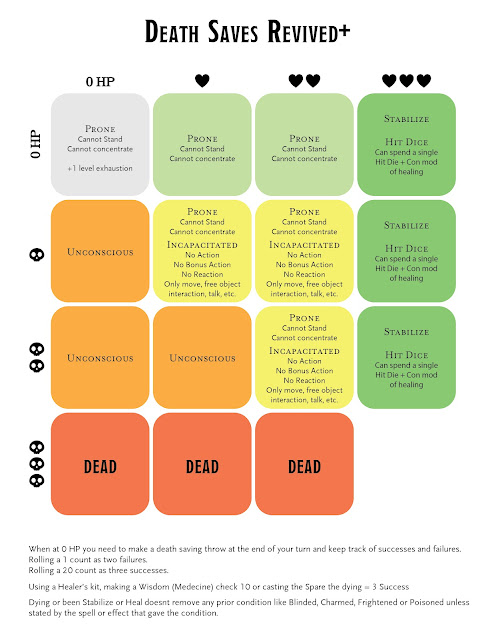
Alternate Death Saves

I came across this alternate method for handling death saves and wanted to pass it along. It looks like a fun system that allows characters to be involved in combat while still giving meaning to the death saves. Does this seem like a good system? Let me know what you think! (Original source)


Thursday, March 16, 2023

Don’t punish players for exploring a dungeon

Although it’s important for dungeons to feel challenging, they should also be fun for the players to explore. When every room is filled with traps, mimics, and hostile creatures, the players won’t want to explore (until the Plot™️ forces them to). We want our players to interact with our content, therefore we should ensure the players feel encouraged to do so.

Here are my thoughts on how to keep dungeons fun:

  1. Not every room needs to have dangerous traps or hostile creatures. Certain areas might even help the players (a healing fountain, for example) or provide the players with useful information.
  2. Clever and careful play should keep the characters safer. One example of this is adding visual indicators for traps to reward observant players. You can also include environmental challenges in lieu of traps to facilitate create problem solving.
  3. When the party does encounter a setback, make sure they are rewarded. After all, why have a trap if there’s no valuable treasure it’s protecting?
  4. Random combat encounters should not turn into slogs. Save your deadly encounters for the boss flight.
  5. Don’t throw in setbacks for the hell of it. They should serve a purpose.
  6. Keep in mind the party’s motivation for entering the dungeon. Overcoming obstacles should move them closer towards their goal (or at least provide some cool information or loot for their troubles). 

(This is something I noticed as a player, not a DM. Being a player and watching other DMs can give you valuable insights and perspectives as to what’s fun and what’s not!)


Tuesday, February 21, 2023

GM Cross-training

In previous articles I’ve talked about the importance of practice as well as my favorite podcasts & blogs for GMs. But there are still countless other ways we can improve as GMs:

  1. Read adventures & sourcebooks. Even if you don’t plan on running a certain adventure, there are tons of ideas you can lift from it. If you’re running a homebrew campaign, it’s particularly useful to see how experienced designers create an adventure.
  2. Design homebrew. Through the process of creating homebrew materials (magic items, monsters, spells, etc.) you will better understand how those things work mechanically.
  3. Watch / listen to actual plays. Each GM has their own techniques they bring to the game. Leverage their experience and ideas to make your game even better.
  4. Play in games as a character. As a player, you can pick up on what makes a game fun and what might not.
  5. Check out different TTRPG systems. Each system has its own way of doing things, and a lot of those cool ideas can be adapted for whatever system you’re running.
  6. Consume fiction. TV shows, movies, and fantasy novels are all great sources of inspiration for plot points, cool locations, NPCs, etc. “We’re only as good as the obscurity of the references we steal from.” –Matt Colville

Let me know other ways you work to improve!